

A deep dive into the rogue class: those shifty characters that work from the shadows and steal to get ahead.
I did a quick overview of all Arkham Horror LCG classes , the Guardian class, and the Seeker class in earlier articles. This week, I wanted to spend more time going a bit more in-depth with the Rogue class. This is my favorite class, and I feel like rogues have a lot of flexibility and have enough money to do whatever they want.
There are 12 rogue characters which range from criminals / gangsters to socialites. Which are also probably criminals. There are some rogues that are more above board in their identities, but all rogues tend to be on the shiftier side. Due to this nature, rogue skills often tend toward using their agility (or foot) to solve their issues.

And, of course, there are always some exceptions. If there is a rule, there is an exception. Or, at least, that’s true of my experiences. For now, I want to focus on the core truths. I mean, you should know the rules before you break them.
After going through the level 0 cards, I felt that a few categories emerged. I was able to identify card draw, investigating, evade, more actions, fighting, over-succeeding, money, skill boosts, and some other miscellaneous cards.
Check out the Game section of MCG for more written reviews or check out the MCG YouTube Channel for Videos and the Reading Rulebooks Podcast!
Over – Succeeding
One of the biggest unique mechanics to the rogue class is over-succeeding for additional benefits. Taking a test can get you the desired result (investigating, fighting, evading) but if you succeed by more than a specified number, than an additional benefit will also be gained. There are a couple of staple rogue cards that really spotlight this mechanic.
The one that immediately comes to mind is “Quick Thinking”. This is a skill card that gives the investigator plus one to any test (since it’s a wild icon). However, if the test succeeds by 2 or more, than the investigator gets the additional benefit of an additional action.


Some other over succeeding benefits include gaining resources, drawing cards, extra damage, or super evading an enemy. Super evading isn’t really a concept in Arkham but I didn’t have a snappy way of saying exhaust an enemy for two turns, and I ruined it by explaining it away…
A rogue can do well in many categories and over succeed can just launch them further into that realm of success.
Money, Money, Money
If you want to be an investigator with a lot of resources, stick to the rogue class. They have many ways of gaining money from gambling on the token bag, over succeeding, stealing from the enemy (parley), investigating for money instead of clues, robbing a bank (play an event), or adding curses.

Honestly, Faustian bargain is a staple among my group. We tend to test skills when there is a decent cushion because we are overly cautious. Which also means that we can (mostly) handle curse tokens. Curses are a negative value and cause you to draw another token. So, 5 resources for something that might not affect the game seems worth it.
You Can’t See Me….

Because Rogues typically have a strong stat in agility, they tend to be good at evade tests which naturally test that skill. And they have quite a few ways to start an evade actions, from tools to events. And, of course, there is always the basic action. And quite a few of these actions do give the super evade.
…But I Can See You!
But avoiding enemies doesn’t necessarily give forward momentum. It just delays the problem (which is all that is needed in some cases). However, the rogue class does take advantage of the enemies’ exhaustion. There are cards that do additional damage after evading or naturally have some sort of advantage against exhausted enemies.


That doesn’t mean that the enemy must be exhausted for a rogue to fight them. Evading to attack is just one of the many tools in the rogue class’s arsenal. I do find it quite funny that backstab, which is a classic rogue fighting card for my group, doesn’t require an exhausted enemy. When I think about backstabbing an enemy when facing them head on just gives me a bit of a laugh.
iNVESTIGATIONS AND cLUES
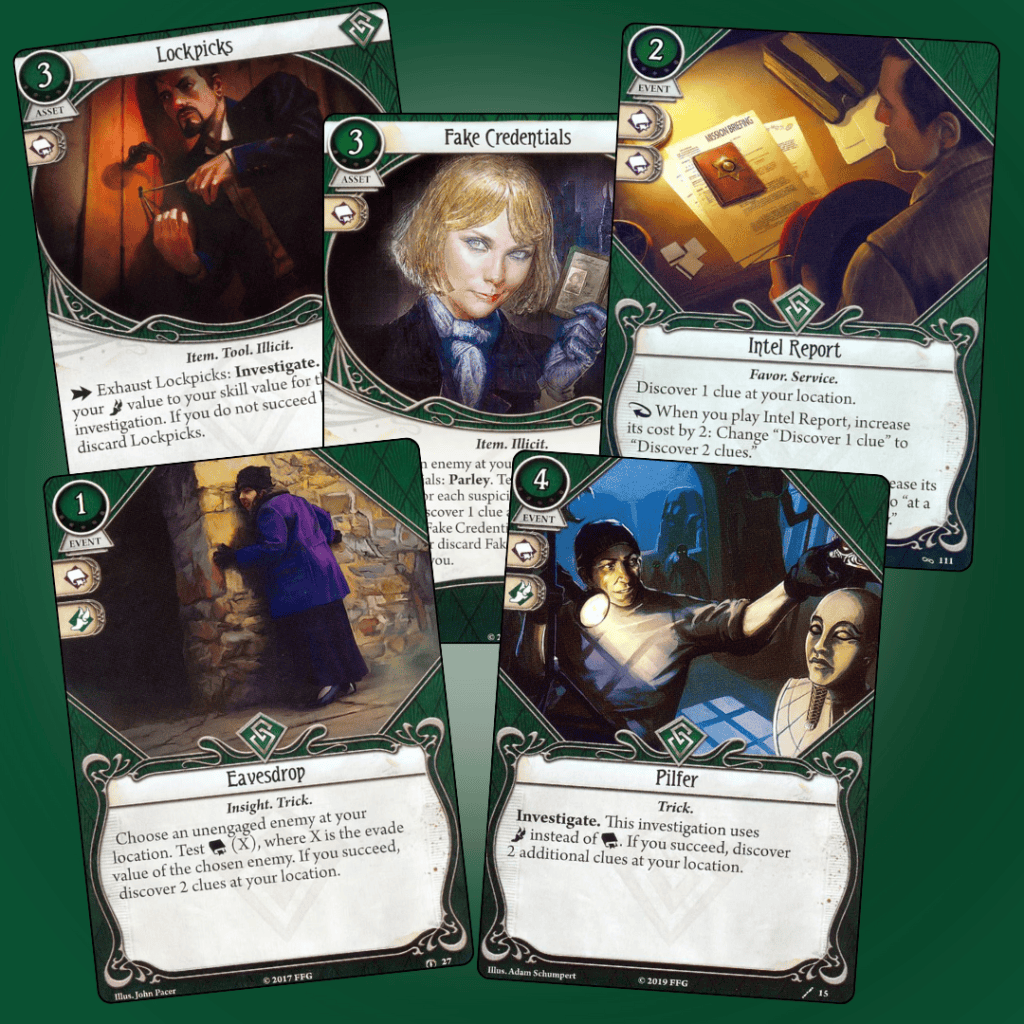
Rogues do have some tools to investigate. I feel like this is a given for all classes as getting clues is how the game advances for most scenarios. The rogue class does modify this by testing agility or even testing against the monsters in the area rather than the location. There are plenty of options on this front, even just paying to get clues.
mORE AND mORE AND mORE

Honestly, I do feel like the core of the rogue class identity is defined by one work: more. They have cards to gain any type of resource. One of the big ones to notice would be the extra actions. There are quite a few ways to gain more actions. I know when I first started playing the Arkham Horror LCG, one card that I was instinctively drawn to was Leo De Luca. A base extra action every turn? How can you say no to that?
Rogues also have some of the best card drawing engines in the game (besides seekers). Given their elusive nature, pickpocketing is one of my favorite cards because it feels like a reward for something that you are already doing. Why not gain a card while evading? It’s just more and more positive momentum.


There are some miscellaneous cards that I wanted to show but I didn’t really know where they fit. Although they do give some interesting benefits. “Let God Sort them out” is just a fun name for a card. And it does give you more XP but it’s not the easiest card to play. “Hidden pocket” is fun because it lets you hold more things. There are a few different paths to explore within the rogue class.





Leave a ReplyCancel reply